Bus Back Panel Advertising in Bangalore: Book Your High-Response Campaign with Chiya Media
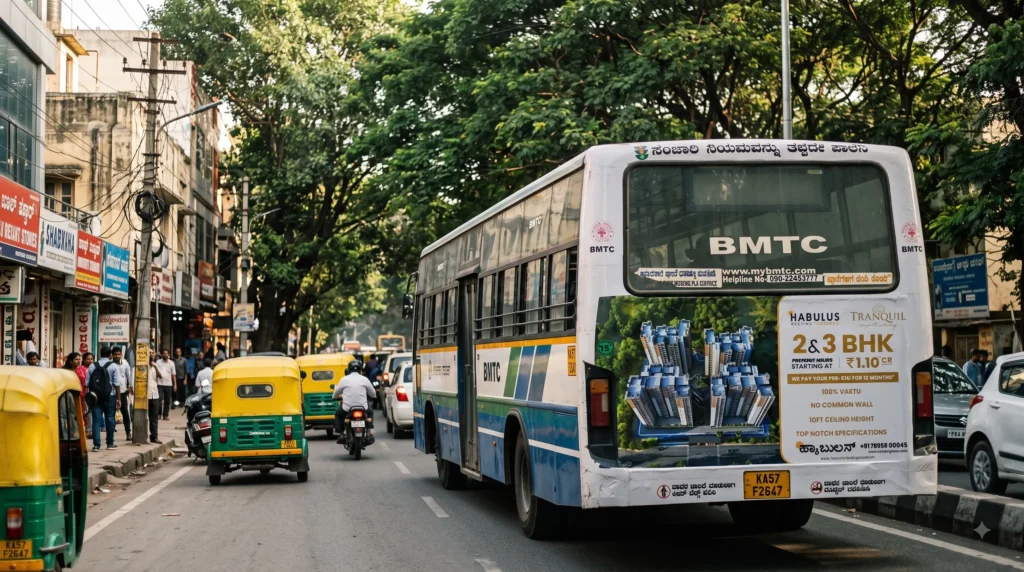
Every time a BMTC bus stops at a Bangalore signal — Silk Board, Hebbal flyover, Outer Ring Road, KR Circle — the vehicles queued behind it have nowhere to look except the back panel. Not for 2 seconds. Not for 5 seconds. For 30 to 120 uninterrupted seconds, every motorist, passenger, and two-wheeler rider behind that bus is a captive audience with your brand directly in their line of sight.
This is the defining advantage of bus back panel advertising in Bangalore — and the reason it consistently delivers the highest direct response rates of any single bus advertising format available in the city.
Unlike a bus side panel that a pedestrian glimpses as the bus passes, or a hoarding that a motorist sees at 40 kmph, bus back panel advertising in Bangalore delivers extended, eye-level, stationary exposure every time the bus stops at a signal. In Bangalore's traffic-heavy road network — where a single bus journey can involve 20 to 40 signal stops — this translates to 20 to 40 distinct, sustained exposure events per bus per route per day.
Chiya Media executes end-to-end bus back panel advertising in Bangalore across BMTC and KSRTC networks — signal-heavy route selection, back panel creative engineering, RTO-compliant installation, and campaign monitoring built specifically for back panel format campaigns. Explore our bus advertisement services in Bangalore or contact us for a free back panel campaign quote.
Why Bus Back Panel Advertising in Bangalore Outperforms Every Other Bus Format for Direct Response
Bus Back Panel Advertising in Bangalore Delivers 30 to 120 Seconds of Captive Dwell Time
The mathematics of outdoor advertising exposure work overwhelmingly in favour of bus back panel advertising in Bangalore. Consider the dwell time comparison across Bangalore's OOH formats:
- Hoarding at a junction: 3 to 6 seconds for a passing motorist at 30 to 40 kmph
- Bus side panel: 2 to 3 seconds for a pedestrian as the bus passes
- Digital OOH screen: 2 to 4-second slot rotation in an attention-divided environment
- Bus back panel at a Bangalore signal stop: 30 to 120 seconds of stationary, direct, eye-level exposure — every signal stop, multiple times per route
At Bangalore's notorious traffic signals — Silk Board Junction (often 90 to 120 seconds), KR Circle, Hebbal flyover approach, Marathahalli Bridge, Electronic City toll approach — a vehicle queued behind a BMTC bus has no choice but to look at the back panel. There is nothing else forward in the line of sight. No competing billboard, no scrolling screen, no passing vehicle to distract — just your brand's creative at eye level, 3 to 5 metres away, for the full signal cycle.
In 90 seconds at Silk Board, a commuter can:
- Read your brand name, service, and tagline in full
- Note or photograph a phone number
- Scan a QR code and navigate to a landing page
- Process a discount offer and decide to act on it
No other bus advertising format in Bangalore creates this conversion moment.
Bus Back Panel Advertising in Bangalore Reaches Every Vehicle Category Simultaneously
Bus back panel advertising in Bangalore has a unique audience advantage that no other OOH format shares: it reaches every vehicle type in the queue behind the bus simultaneously — cars, bikes, autos, other buses, trucks, and any passenger inside those vehicles. A hoarding reaches road users facing that specific direction at that specific point. A bus back panel reaches every road user behind the bus for the entire duration of every signal stop.
On a signal-heavy route like Outer Ring Road or Hosur Road, a single BMTC bus generates back panel exposure across hundreds of vehicle occupants per hour — the cumulative reach equivalent of a premium junction hoarding at a fraction of the per-impression cost.
Bus Back Panel Advertising in Bangalore Converts Impressions Into Actions
The extended dwell time of bus back panel advertising in Bangalore at signal stops creates something most OOH formats cannot: an action window. A commuter with 60 seconds at a signal and a smartphone in hand can act on your back panel CTA immediately — not "maybe later when I remember," but right now, at the signal, before the light changes.
This is why Chiya Media consistently observes higher direct enquiry response rates from back panel placements than from equivalent side panel campaigns running simultaneously on the same fleet. A back panel with a QR code at a high-signal route stop converts a 60-second exposure into an app download, a form submission, a phone call, or a website visit — something very few passive OOH impressions achieve.
How to Plan Bus Back Panel Advertising in Bangalore
Signal-Heavy Route Selection for Bus Back Panel Advertising in Bangalore
The difference between an average bus back panel advertising in Bangalore campaign and a high-performing one comes down to signal stop density. Every BMTC route has a different number of signal stops — and the more signal stops a route has per journey, the more captive dwell-time exposures your back panel generates per day.
Chiya Media selects routes for back panel campaigns based on signal stop count and signal duration data — not just passenger volume. The routes that deliver the highest back panel performance in Bangalore:
High-signal-density routes for bus back panel advertising in Bangalore:
- Outer Ring Road (Silk Board to KR Puram): Bangalore's most congested arterial road, with signal stops at every major junction — Silk Board, HSR Layout signal, Marathahalli, ITPL junction, KR Puram. Signal durations at Silk Board regularly exceed 90 seconds. Back panels on ORR routes deliver the highest per-signal dwell-time in the city.
- Hosur Road (Silk Board to Electronic City): Tech park approach road with long signal cycles at Electronic City toll plaza approach, Bommanahalli signal, and Kudlu junction — reaching IT professional commuters during their daily tech park commute with extended signal exposure.
- Old Madras Road (KR Puram to MG Road): Signal-heavy Central Bangalore approach with stops at Baiyappanahalli, Indiranagar, and MG Road junction — reaching mixed professional and commercial commuter audience.
- Bellary Road (Hebbal to MG Road): Major North Bangalore arterial with extended Hebbal flyover approach signals — reaching airport corridor commuters and North Bangalore residential traffic.
- Bannerghatta Road (JP Nagar to City Market): South Bangalore residential approach with signals at JP Nagar 7th Phase, Bilekahalli, Jayanagar — reaching South Bangalore family and professional commuter base.
- Tumkur Road (Peenya to Majestic): West Bangalore industrial corridor with signals at Peenya junction and Rajajinagar — reaching industrial workforce and West Bangalore trading community.
Chiya Media maps signal stop data to route selection for every bus back panel advertising in Bangalore campaign — ensuring your fleet is on routes where signal exposure is maximum, not just where passenger volume is highest.
Fleet Sizing for Bus Back Panel Advertising in Bangalore
Fleet sizing strategy for bus back panel advertising in Bangalore differs from side panel campaigns because the back panel's impact comes from signal stop frequency rather than geographic spread. A smaller fleet of back panel buses on signal-heavy, high-dwell-time routes consistently outperforms a larger fleet of side panel buses at equivalent spend for direct-response campaign objectives.
Recommended back panel fleet sizes by objective:
| Campaign Objective | Fleet Size (BMTC) | Route Strategy & Duration |
|---|---|---|
| Response-driven campaigns (enquiries, app downloads, lead generation) | 10 to 15 buses | 3 to 5 high-signal-density routes — concentrated signal exposure on key corridors for 30 to 60 days. |
| Brand awareness + response combination | 15 to 25 buses | 5 to 8 routes — a mix of high-signal central routes (for response) and residential corridor routes (for catchment awareness). |
| City-wide back panel saturation | 25 to 40 buses | 10 to 15 routes covering all major Bangalore corridors for maximum city-wide route coverage simultaneously. |
Creative Strategy for Bus Back Panel Advertising in Bangalore
Bus back panel advertising in Bangalore creative is engineered for the signal stop environment — a different creative logic from side panel design, because the audience conditions are fundamentally different. At a signal stop, your viewer is stationary, close, and has time. Use it.
- Brand name — large, first, unmistakable: Even with 60 seconds of dwell time, the brand name must be the first element the eye lands on. Large, bold, high-contrast brand name at the top third of the back panel — readable at 10 metres before the signal dwell even begins.
- Offer or benefit — one specific, credible claim: "Home Loans at 8.5%," "Admissions Open — Apply by 31 May," "Same-Day Delivery | Order Before 2 PM," "20 Lakhs Life Cover at ₹500/Month." The back panel's dwell time allows for a more detailed benefit statement than a side panel — use it with one specific, compelling offer. Not a list of benefits. One strong, specific claim.
- QR code — right side, minimum 8cm × 8cm: Bus back panel advertising in Bangalore is the only bus advertising format where QR codes consistently drive measurable app downloads, form fills, and website visits — because signal stop dwell time gives commuters enough time to open their camera, scan, and navigate. Chiya Media places QR codes on the right side of every back panel at a minimum 8cm × 8cm size — large enough to scan from 3 metres away through a car windscreen. The QR destination must be mobile-optimised and load in under 3 seconds.
- Phone number — short, memorable, large: If your campaign objective is phone enquiries, a short, memorable phone number at the bottom of the back panel in the largest possible font drives the highest call-through rate. A 10-digit mobile number at 80mm font size is readable, memorable at signal dwell distance, and actionable by the time the light changes.
- CTA — one only, no exceptions: Never put a phone number AND a QR code AND a website URL on the same back panel. The audience has 60 seconds — enough to act on one CTA, not to choose between three. Chiya Media's back panel creative rule: one CTA per panel, determined by the campaign's primary conversion objective.
Bus Back Panel Advertising Formats in Bangalore
Standard Back Panel — Bus Back Panel Advertising in Bangalore
The standard back panel is the primary and most widely available format in bus back panel advertising in Bangalore — a printed vinyl panel mounted on the rear face of a BMTC bus, sized to cover the full available rear display area.
Standard back panel specifications:
- Dimensions: approximately 120cm × 90cm (varies by BMTC bus model — Chiya Media provides model-specific dimension templates)
- Material: UV-resistant, weather-grade vinyl rated for Bangalore's monsoon season and summer heat
- Printing: full-colour digital print at minimum 720 DPI for outdoor resolution
- Installation: RTO-compliant mounting on approved rear panel zones, free from window, brake light, and license plate obstruction
- Visibility: eye-level from following vehicles at 2 to 6-metre queue distance
Extended Back Panel — Bus Back Panel Advertising in Bangalore
Extended back panel placements cover a larger rear surface area on BMTC buses where the bus body design allows — providing a bigger creative canvas for brands with more complex messages or multiple creative elements (pack shot, brand name, offer, QR code, and phone number).
For brands running bus back panel advertising in Bangalore for the first time, Chiya Media recommends the standard back panel as the starting format — then scaling to extended panels on premium routes after establishing baseline campaign performance.
Who Gets the Highest ROI from Bus Back Panel Advertising in Bangalore
Education and Coaching Institutes Booking Bus Back Panel Advertising in Bangalore
Admissions deadline campaigns are the strongest use case for bus back panel advertising in Bangalore in the education category. "Apply Before 31 May | JD Institute — Fashion Design, Interior Design | Scan to Apply" on a back panel at Jayanagar, Banashankari, and Koramangala signal stops reaches student commuters during 60-second signal dwell time — long enough to scan the QR code and initiate an application.
Chiya Media places education back panel campaigns on routes with high signal stop density in student residential zones during the February to May admissions window — the highest-conversion timing for education back panel placements.
Real Estate Developers Booking Bus Back Panel Advertising in Bangalore
A real estate back panel with a project name, location hook, price anchor, and phone number — "Sarjapura Road | 2 BHK from ₹58 Lakhs | Call [Number]" — generates direct sales enquiries at signal stops from buyers already commuting near the project zone. Chiya Media places real estate back panels on routes serving the buyer residential corridors and project approach roads that generate the highest enquiry conversion for property clients.
Fintech and Banking Brands Booking Bus Back Panel Advertising in Bangalore
For fintech app download campaigns and loan product enquiry campaigns, bus back panel advertising in Bangalore with QR codes is the highest-performing OOH format available. At signal stops on IT corridor routes — Outer Ring Road, Whitefield, Electronic City — smartphone-equipped IT professional commuters in queued vehicles have the time, the device, and the inclination to scan a back panel QR code linking to an app store or a loan eligibility calculator.
Healthcare Brands Booking Bus Back Panel Advertising in Bangalore
Hospital and clinic brands use back panels with helpline numbers and appointment QR codes on routes through residential patient catchment zones. A hospital back panel saying "24/7 Emergency | Advanced Cardiac Care | [Helpline Number]" — visible at 60 seconds per signal stop throughout a residential commuter's daily journey — builds both awareness and provides an immediately accessible contact CTA that can be acted on before the commuter reaches home.
FMCG and Retail Brands Booking Bus Back Panel Advertising in Bangalore
Retail brands use back panels on high-signal routes approaching mall and retail destination zones — "Flat 50% Off | [Brand] | Whitefield Mall | This Weekend" — reaching shoppers in approach-corridor traffic queues with sale messaging at the point of closest proximity to a purchase decision. See our full retail campaign approach on our bus advertisement services page.
Bus Back Panel Advertising Cost in Bangalore
Bus back panel advertising in Bangalore is priced as part of the per-bus campaign rate — the back panel is one of the placement zones within a BMTC bus booking. Rates vary by:
- Bus type: Non-AC BMTC buses (lowest rate), AC Vajra (mid-tier), Volvo AC (premium rate)
- Campaign duration: Minimum 30 days; rates per campaign cycle
- Fleet size: Per-bus rate is consistent; total campaign cost scales linearly with fleet size
- Production: Vinyl printing and installation included in Chiya Media's campaign rate — no separate production invoice
Chiya Media provides fully itemised, transparent bus back panel advertising in Bangalore quotes — with per-bus rate, total fleet cost, production, and GST shown separately. No hidden charges, no ambiguous package pricing.
How to Book Bus Back Panel Advertising in Bangalore with Chiya Media
Step 1 — Define Your CTA and Conversion Objective
Before briefing a bus back panel advertising in Bangalore campaign, confirm your primary CTA: phone enquiries, QR code scans, app downloads, or website visits. The CTA determines the creative layout, QR code size, phone number format, and landing page specification — all of which need to be ready before production begins.
Step 2 — Review Our Back Panel Campaign Portfolio
Visit Chiya Media's bus advertisement services page to see past back panel campaigns across education, real estate, FMCG, fintech, and healthcare clients — including creative examples and route placement data.
Step 3 — Submit Your Campaign Brief
Contact Chiya Media with your brand name, CTA type, target audience geography, preferred campaign duration, and budget range. Our planning team maps your brief to the highest-signal-density BMTC routes for your audience zone.
Step 4 — Receive Your Signal-Route Plan and Back Panel Proposal Within 48 Hours
Chiya Media delivers a route-by-route back panel campaign proposal — specific BMTC route numbers selected for signal stop density, fleet size recommendation, QR code or phone number CTA integration plan, and fully itemised cost breakdown — within 48 hours of your brief.
Step 5 — Approve Creative and Launch Your Back Panel Campaign
Our design team engineers back panel-specific creative — large brand name, single benefit claim, one CTA, QR code at optimal scan size — for your approval before production. Chiya Media installs and verifies all back panels with pre-launch photographic proof. Mid-campaign monitoring ensures full fleet deployment throughout the campaign period.
Book Your Bus Back Panel Campaign in Bangalore Today
Ready to capture high-dwell-time signal exposure across Bangalore's most heavily congested transit corridors?
Chiya Media Solutions delivers end-to-end bus back panel campaign execution, route mapping, RTO-compliant vinyl printing, and performance monitoring.
Book your bus back panel advertising in Bangalore with Chiya Media — Get your free quote now →